Fans are useful in hot rooms, but only when they have a clear job. A fan can move air across your body, push hot air out of a room, or help pull cooler outdoor air through a home. What it cannot do is magically remove all the heat from a sealed room.
The best fan setup changes through the day. In the afternoon, shade and closed windows may matter more than airflow. In the evening, a window fan can help exhaust trapped heat if outdoor air is finally cooler. In a bedroom, the goal may be quiet, indirect comfort rather than a wind tunnel aimed at your face.
Quick answer: For a hot room, block direct sun first, keep windows closed while outdoor air is hotter than indoor air, ventilate when outside becomes cooler, and place fans for one clear job: exhaust hot air, create a cross-breeze, or move air gently across people.
| Situation | Best fan setup | What to avoid |
|---|---|---|
| Hot room after sunset | Point one fan outward from the hottest window and open a cooler shaded intake elsewhere. | Opening every window before outside air is cooler. |
| Bedroom at night | Place a fan several feet away and aim airflow across the bed, ideally with oscillation. | Blasting air directly into your face from close range. |
| One-window apartment | Use the window fan as exhaust when outdoor air is cooler; move indoor air toward that window. | Expecting a true cross-breeze from one opening. |
| Kitchen heat | Reduce cooking heat first, then exhaust warm air when it is safe and useful. | Pointing a portable fan at a gas flame. |
| Empty room | Turn the fan off unless it is actively ventilating cooler air through the space. | Running a fan for hours with no ventilation purpose. |
Before you move the fan, control the sun
A fan works better when the room is not being heated by direct sunlight. Start with the window, not the plug.
Close blinds before sunny windows heat the room
If a living room gets strong west-facing sun at 3 p.m., close blinds or curtains before the sun lands on the floor and furniture. A light-colored shade close to the glass is often more helpful than a dark curtain hanging far away. In a rental apartment, removable blackout curtains or tension-rod shades can be a simple upgrade.
Ventilate only when outside air helps
Use a basic thermometer and compare indoor air with shaded outdoor air. Keep windows closed when it is hotter outside than inside. Open them when outdoor air becomes cooler, air quality is acceptable, and security is not a concern. For a full decision guide, see Should You Open Windows During a Heatwave?.
Trick 1: Exhaust hot air after sunset
When a room stores heat all day, the fastest useful fan job is often exhaust. Place a box fan or sturdy window fan near the hottest window facing outward. The goal is to push stale, warm indoor air outside.
Open a cooler intake elsewhere
An exhaust fan needs replacement air. Open a shaded window or secure door on the cooler side of the home. In a small apartment, that might mean a bedroom window as the intake and a living-room window as the exhaust. Keep interior doors open so air has a path.
Trick 2: Build a cross-breeze
A cross-breeze works when air can enter from one side and leave from another. Opposite windows are ideal, but you can also use a bedroom window and a hallway or kitchen window if they connect through open doors.
Use the tissue test
Hold a tissue, ribbon, or lightweight curtain near the opening. If it barely moves, the air path is weak. Move the fan, open a second interior door, or switch from intake to exhaust. This low-tech test quickly shows whether the setup is doing useful work.
Trick 3: Aim across the occupied zone
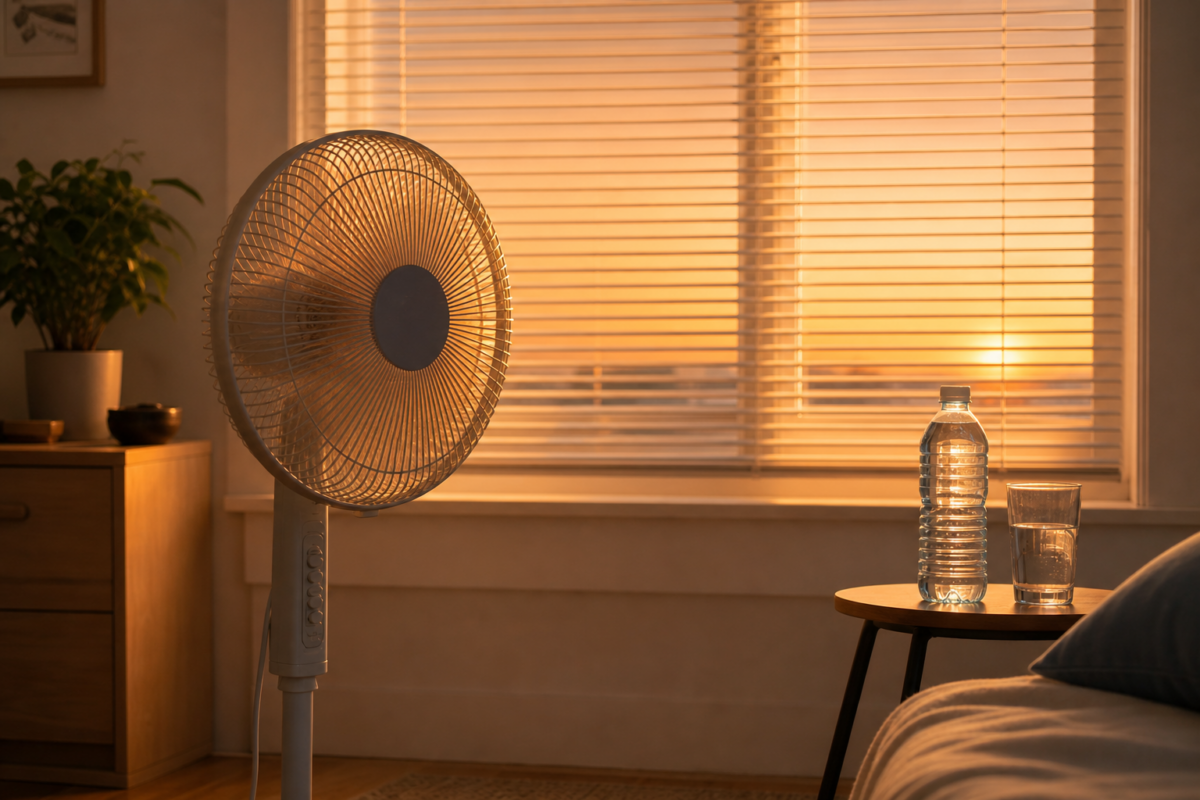
When windows need to stay closed, a fan is mostly for personal comfort. Place it several feet away and aim airflow across where people sit or sleep. Avoid pointing it at a wall from six inches away. That creates noise without much benefit.
Adjust height and oscillation
In a living room, set the fan around chair or sofa height. In a bedroom, aim it across the bed rather than straight into your face all night. Oscillation can make airflow gentler and reduce the dry, blasted feeling that makes people turn the fan off at 2 a.m.
Trick 4: Use a doorway fan in awkward apartments
Many apartments have windows on only one side. If there is no true cross-breeze, use a fan in a doorway to move air from a cooler room into a warmer one, or to push warm bedroom air toward a better exhaust window.
Example: studio apartment
In a studio with one sunny window, keep that window shaded during the day. In the evening, open it if outdoor air is cooler and place a fan facing outward. If the bathroom or entry hall is cooler, use a second fan to move air from that area toward the window path.
Trick 5: Cool the kitchen without spreading heat
Kitchens can overpower a fan setup. Ovens, long stovetop cooking, dishwashers, and dryers all add heat. During a heatwave, choose no-cook meals, microwave shortcuts, or early-morning prep when practical.
Exhaust after cooking
If you cook, ventilate once outdoor air is cooler or use a kitchen exhaust fan if you have one. A portable fan can help push warm kitchen air toward an open window, but never point a fan at a gas flame. For food ideas that avoid heating the room, try 10 No-Cook Meals for Hot Weather.
Trick 6: Pair fans with shade, not sunlight
A fan blowing across a sunlit room can feel like moving warm air around a toaster. For sunny windows, shade first, then use airflow. Close blinds before direct sun arrives; open the window later only if outside air is cooler.
Example: west-facing bedroom
Keep the blind closed from midday through sunset. After outdoor air drops below the bedroom temperature, open the window and point one fan outward for 20 to 40 minutes. Then switch to indirect airflow across the bed if the room feels fresher.
Trick 7: Turn off hidden heat sources
Fans feel less effective when the room is still producing heat. Switch off unused gaming consoles, desktop computers, bright lamps, extra monitors, and charger clusters. Delay laundry and dishwashing until cooler hours if your household schedule allows.
For a broader room plan, read How to Cool a Room Without AC and Apartment Cooling Tips That Actually Help.
Common fan mistakes that make heat worse
Opening windows too early
If outdoor air is hotter than indoor air, a fan near an open window may pull more heat inside. Wait until outside air is cooler, then ventilate with a clear intake and exhaust path.
Running a fan in an empty sealed room
A fan does not cool furniture, walls, or air the way air conditioning does. In an empty sealed room, it usually just uses electricity and adds a little motor heat. Turn it off unless it is helping ventilation.
Pointing airflow at the wrong target
A fan blasting a nearby wall, curtain, or pile of laundry is mostly noise. Aim it across people, toward an exhaust window, or through a doorway where air can actually move.
Ignoring heat sources
One fan cannot compete with an oven, dryer, gaming PC, or direct sun on the floor. Reduce the heat source first, then use the fan to improve comfort or airflow.
A simple evening fan routine
- Compare temperatures. Wait until outdoor air is cooler than indoor air.
- Open a cooler intake. Choose a shaded, secure window with acceptable air quality.
- Exhaust the hottest room. Point one fan outward from the warmest window.
- Clear the path. Open interior doors between intake and exhaust.
- Reduce heat sources. Shut down electronics and avoid oven use.
- Set the bedroom fan. Aim it across the bed, not directly at your face.
- Close up in the morning. Shut windows and blinds before outdoor heat returns.
Frequently asked questions
Should a window fan point in or out?
Point it outward when you are exhausting hotter indoor air. Point it inward only when outdoor air is cooler, clean enough, and safe to bring inside.
Does a fan cool an empty room?
A fan mainly moves air and helps people feel cooler. Turn it off in an empty room unless it is actively helping ventilation.
Can fans be unsafe in extreme indoor heat?
Fans should not be relied on during dangerous indoor heat, especially around or above 90°F/32°C. Follow local health guidance and move to a cooler place if symptoms worsen.
Is ice in front of a fan worth trying?
It may feel cooler nearby for a short time, but it will not cool a whole room like air conditioning. Treat it as a small comfort experiment, not a safety plan.
Sources and safety guidance
For heat safety basics, see the CDC’s About Heat and Your Health guidance. You can also build a household plan with the Heatwave Survival Kit Checklist and review Heat Exhaustion Warning Signs to Know.